top of page
In the Heart
of
South
London


A Member of


Our Beautiful Church Organ
Dedicated in 1915, it is widely regarded as one of the finest instruments in London,
known for its tonal integrity and its suitability for a vast range of musical styles.

The Organ
The organ of Penge Congregational Church was built in 1915 by the famous organ building firm of T C Lewis & Company of Brixton. In 1984-85 the instrument was rebuilt and restored by Brian H Bunting of Epping, Essex.
The organ console (where the organist plays) is in the chancel area at the front of the church, on the left hand side facing the congregation just beyond the choir stalls.
The organ has three keyboards (known as ’manuals’) and a pedalboard played by the feet. Each manual operates an organ division.
The order of the manuals follows the English scheme: the Great Organ is the middle manual, the Swell Organ is the top manual, and the Choir Organ is the bottom manual.
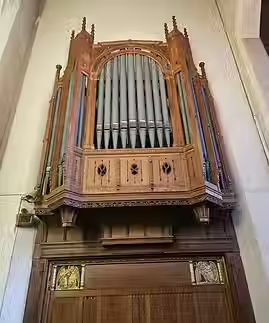
The organ case was designed by the church’s architect, P Morley Horder, and is divided on both sides at the front of the church. The Great, Swell and Pedal organ divisions are on the left, and the Choir organ division is on the right.
The organ stops control the sounds the organ makes. A stop is a set of pipes, usually one for each note on the manual or pedalboard, and is operated at the console by a drawstop on the left or right of the organist.
There is a Swell pedal which operates the shutters of the Swell box and controls how loud or soft the Swell Organ sounds.
There are lots of thumb and toe pistons which help the organist select groups of stops all in one go.
These can be programmed using the piston setter board which contains 186 switches.
The organ is listed in the National Pipe Organ Register .For technical details please see below.
After many decades of sterling service, parts of this instrument are now in urgent need of restoration. We are raising funds for this purpose on behalf of Penge Congregational Church. As very small organisations we are dependent upon the generosity of the general public to keep this instrument alive and are grateful for any and all contributions.
In June 2026 the bellows were repaired. The last time they were repaired was 70 years ago.
Fun fact! The organ pipes that you see in the church are for show only.
The sound of the organ is produced from pipes hidden behind
.
Technical details
Builders
1915 T C Lewis & Company
1984/5 Rebuild by Brian H Bunting, Epping, Essex
1986 Unknown builder - Cornet replaced Open Diapason No.1
Case P Morley Horder FRIBA
Position: Divided, each side of chancel
Great Open Diapason 8’
Stopped Diapason 8’
Octave 4’
Flûte Harmonique 4’
Super Octave 2’
Mixture III
Cornet II
Trumpet 8’
Swell Lieblich Bourdon 16’
Geigen Principal 8’
Rohr Flute 8’
Viole da Gamba 8’
Voix Célestes 8’
Geigen Principal 4’
Fifteenth 2’
Mixture III
Contra Oboe 16’
Horn 8’
Tremulant
Choir Lieblich Gedact 8’
Principal 4’
Stopped Flute 4’
Piccolo 2’
Larigot 1 1/3’
Clarinet 8’
Tremulant
Trumpet 8’
Clarion 4’
Pedal Great Bass 16’
Sub Bass 16’
Lieblich Bourdon 16’
Principal 8’
Flute Bass 8’
Fifteenth 4’
Flute 4’
Trombone 16’
Trumpet 8’
Console
Console type: Detached
Stop type: Drawstop
Label font: Sans Serif Caps
Pedalboard: Radiating concave
Angled Jambs
"Lewis" drawstop knobs
Couplers
Swell to Pedal Swell octave Choir to Great Great to Choir
Swell to Great Swell suboctave Choir to Pedal
Swell to Choir Swell unison off Great to Pedal
Blower Electric
Accessories
Balanced Swell Pedal
5 + 5 toe pistons
Great to Pedal toe piston
Great and Pedal pistons combined drawstop
5 Thumb pistons per manual
5 Reversible Thumb pistons to couplers
One additional Swell thumb piston which produces 8' Oboe by drawing 16' Contra Oboe with
Octave and Unison Off
Ventil to Trumpet
Piston setter board with 186 switches

bottom of page